Hurricane Fuel Economy

This is the indicated MPG on the Fuel Economy gauge at the mileage listed below. I reset the gauge at each 1,000 mile interval.

November @ 1952 miles - 17.9 MPG
December @ 3005 miles - 18.0 MPG
January @ 4012 miles - 17.3 MPG
February @ 5002 miles - 15.6 MPG
February @ 5999 miles - 17.4 MPG
March @ 7000 miles - 16.6 MPG
April @ 8013 miles - 16.4 MPG
May @ 9056 miles - 25.2 MPG (not a typo, took a trip on meandering highways at ~50 mph)
May @ 10000 miles - 19.7 MPG
June @ 11000 - 19.2 MPG
July @ 12105 miles - 19.3 MPG
I’m surprised you’re not getting a bit better mileage. I can only speak from my experience with the V8 but I have noticed a large improvement in fuel mileage since I traded in my 2017 ram outdoorsman(v8 with the 392 rear end) for a 2023 Ram 1500 sport(in Canada sport is a trim between big horn and Laramie) with the 321 rear end. Btw the 2023 has the transfer case with 4wd auto but the 2017 truck only had 4hi 4lo and 2wd.
I had to convert these from L/100 to us mpg but on a freeway trip doing around 72 mph I get around 18.8 to 21 depending on conditions with the 321 rear end. With the 392 rear end I would get under 18 mpg up to 19.
In city driving the 392 was great and had a lot of torque but would use way more fuel. In city only driving (I’m not easy on the gas) I would see as bad as 13 mpg in the 392 but the 321 rear end rarely shows worse than 15mpg.
I did see great improvements with both on 2 lane highways maxing out at 60mph. There I would meet or exceed the epa numbers which were a bit exaggerated especially on the 392. On those trips the 392 would hit 21.3 on average in perfect conditions and the 321 can hit 23 mpg.
So much can have to do with what your truck has on it, how much that setup weighs. Does it have a lift and what tires are on it.
I hope this helps in some way. I wouldn’t hesitate to get the turbo 6 in my next truck but that is a while off. I still have smiles per mile right now.
Btw, I’m not sure if it’s true for the straight 6 but on every v8 I’ve owned the mileage was much worse until my engine had about 6000 miles on it then it improved dramatically.
 
3rd Tank. Sunday drive in the country. A lot of 50 mph with stops in small towns.
Indicated MPG - 21.9
Costco Premium

The rest of the tank with normal commuting.
Indicated MPG - 17.6
Calculated MPG - 17.05
I am still at about 16 mpg. If you now notice the advertisements they dropped it to 17 MPG. I live in a hilly area in AZ, so constantly climbing those hills is affecting the mileage.
 
Well the 25 number looks good. That's where I was hoping the hurricanes would consistently be. But 17-19 in the real world is what I've been hearing. I think you said you had a 2.7 Ford before? How do they compare? Have you thought about getting a oil analysis done? I just did it on my 23 hemi it was pretty interesting.

I really liked the 2.7. It always impressed me with fuel economy, and I never felt like I needed more power. I liked that Ford added a dual injection system (port on startup, direct at operating temperature) in 2018 to mitigate carbon fouling on the valves. Getty’s Garage (YouTube) has done several videos on the design and performance of the Ford 2.7, and it sounds like the most competently designed half ton engine on the market. It is designed and built like a diesel. (Cast and fractured main bearings, Closed deck CGI block, offset connecting rods, variable geometry turbos, no cylinder deactivation)
120 hp/L - 148 ft lbs /L

Whether we like it or not, the Hurricane is in a league of its own. Even the Standard Output is a very high performance motor.
140 hp/L - 156 ft lbs /L
There is a long list of good design elements in the Hurricane with some (ultra high pressure fuel system, liquid vs. air intercooling and variable oil pressure system) that we’ll have to wait and see about.

I may do oil analysis. I’ve done it on other engines, but I’m inclined to think that it is best done repeatedly, using the same oil type over numerous oil changes.
 
I really liked the 2.7. It always impressed me with fuel economy, and I never felt like I needed more power. I liked that Ford added a dual injection system (port on startup, direct at operating temperature) in 2018 to mitigate carbon fouling on the valves. Getty’s Garage (YouTube) has done several videos on the design and performance of the Ford 2.7, and it sounds like the most competently designed half ton engine on the market. It is designed and built like a diesel. (Cast and fractured main bearings, Closed deck CGI block, offset connecting rods, variable geometry turbos, no cylinder deactivation)
120 hp/L - 148 ft lbs /L

Whether we like it or not, the Hurricane is in a league of its own. Even the Standard Output is a very high performance motor.
140 hp/L - 156 ft lbs /L
There is a long list of good design elements in the Hurricane with some (ultra high pressure fuel system, liquid vs. air intercooling and variable oil pressure system) that we’ll have to wait and see about.

I may do oil analysis. I’ve done it on other engines, but I’m inclined to think that it is best done repeatedly, using the same oil type over numerous oil changes.
The hurricanes are very stout. I seen one swapped into a old d100 that put 630 to the tire. Had the 8 speed trans. And it sounded wicked! But I was hoping for better fuel economy for the standard output version. Maybe in a mid size truck it could do better, I think that's a segment that could use some good competition on the fuel mileage side.
 
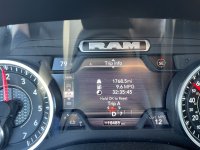
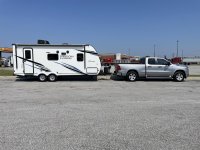
1700+ mile trip from Alabama to Utah towing a 24-1/2” (bumper to hitch) 6000 gvwr camper @ 65 mph most of the way. Premium fuel.

9.6 mpg indicated.

When I hand calculated each tank it was within 2/10 of a mile per gallon of the trip meter. (Which is more accurate than normal mixed driving at home.)
 

Attachments

  • IMG_6377.jpeg
    IMG_6377.jpeg
    3 MB · Views: 7
  • IMG_6169.jpeg
    IMG_6169.jpeg
    4 MB · Views: 8
  • IMG_6168.jpeg
    IMG_6168.jpeg
    3.9 MB · Views: 7
1700+ mile trip from Alabama to Utah towing a 24-1/2” (bumper to hitch) 6000 gvwr camper @ 65 mph most of the way. Premium fuel.

9.6 mpg indicated.

When I hand calculated each tank it was within 2/10 of a mile per gallon of the trip meter. (Which is more accurate than normal mixed driving at home.)
Nice! Looks like fun.

It seems that your weight distributing hitch is set a little too aggressive as you have more weight in the front than the rear and that your nose on the trailer is up instead of being level with your truck.
 
1700+ mile trip from Alabama to Utah towing a 24-1/2” (bumper to hitch) 6000 gvwr camper @ 65 mph most of the way. Premium fuel.

9.6 mpg indicated.

When I hand calculated each tank it was within 2/10 of a mile per gallon of the trip meter. (Which is more accurate than normal mixed driving at home.)
I'd say that's pretty good fuel economy myself for a full-size truck towing that much weight and about 1 MPG better than my RHO. This makes sense with to me with the RHO's tires and higher stance for wind resistance.
 
Nice! Looks like fun.

It seems that your weight distributing hitch is set a little too aggressive as you have more weight in the front than the rear and that your nose on the trailer is up instead of being level with your truck.
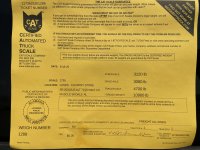
I don’t know how much that is fish eye effect from the cell phone picture, and how much was the slope of that parking lot. It towed well and the distance from the top of each tire to the wheel well was almost equal. I never had any sway in the wind. That is 811lbs on the rear axle compared to empty. I did carefully follow the instructions for the Andersen WDH. There are urethane bushings that are compressed as you tension the chains. If you overdo it, it looks weird.

When I head back home, I’ll scale it again and see what I get. My first reading at that scale was way off. I drove around for a reweigh.
 
Almost home:
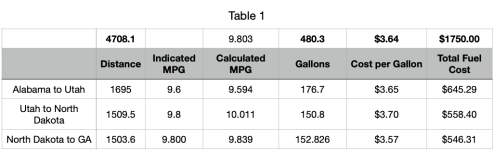
Fuel cost totaling exactly $1750 so far is an odd coincidence. I was towing the trailer shown in previous posts above. I'll insert a post with the various CAT scale readings when I get back to Alabama. The calculated and indicated MPG was consistently within .5 mpg, usually much closer. Per page 349 of the manual, I ran premium almost exclusively while towing. I usually set the cruise to 65 MPH.

The engine had plenty of power and the truck always felt planted. Coming south through South Dakota I was getting less than 7 MPG. Since the engine didn't feel like it was struggling at all, I wasn't on any significant grade, and wasn't gaining any elevaltion so I wondered what could possibly be causing it. When I stopped for gas, there were heavy winds ~20 MPH plus from the south, with gusts to ~35 MPH. After that, I set the cruise to 60 MPH until I got out of the headwinds. Regardless of mountain ranges or head winds, I just set the cruise and the engine kept speed. Transmission likes to run at ~180 degrees. Coolant and oil like to run at ~210. Once or twice coolant and oil temps got just over 220 on a grade, but never stayed there.
1761106745993.png
 
Back
Top