How automakers calculate GVWR and curb weight

testerdahl

Administrator
Staff member
I've been working on this for about a week and I'm not sure I am any closer, but I'm curious to know if you care. Do you want to know how automakers actually calcuate GVWR?

The closest I've gotten is: "GVWR is something that the manufacturer sets based on FMVSS (safety) and emissions requirements along with loading limits for tires, axles, frames, etc."

Then, they factor in some people. The people part is rather interesting.

You see they have people factored into the curb vehicle weight, but not payload.

Ford says they account for 150 lbs per seat belt. So a crew cab truck is 5, so that's 150 x 5.

Ram said "Our standard weight data accounts for a 15th percentile male and a 40th percentile female as a driver in the truck, which is the statistical norm according to engineering." Ram also has the image below on their website.

Toyota said, "We account for two AM50 occupants." I Googled that and came up with:
  • Women: ~170.8 lbs (average height of 5'3.6")
  • Men: ~197.8 lbs to 199.8 lbs (average height of 5'9")

Chevy/GMC didn't get me an answer from engineering, but they did state this in a 2023 trailering guide. "Maximum Trailer Weight Rating This rating is determined by subtracting the towvehicle’s weight (curb weight) from the Gross Combination Weight Rating (GCWR).Base vehicle (curb) weight plus 150 lbs. each for the driver and a front passengeris used, so additional passengers, equipment and cargo weight reduce this rating."

The official definition of curb weight is:
Curb weight means the actual or the manufacturer's estimated weight of the vehicle in operational status with all standard equipment, and weight of fuel at nominal tank capacity, and the weight of optional equipment computed in accordance with § 86.1832-01; incomplete light-duty trucks shall have the curb weight specified by the manufacturer.

That's from the code of Federal Regulations.
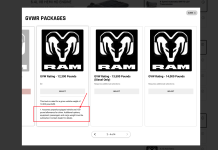
image001.png
 
So what does all this mean? Is it a story? Man, I don't know. LOL. I have had this stuff sitting in my inbox for two weeks. It all came from a dealer friend of mine who emailed me. He had a customer who was paranoid with over analyzing his weights when towing. He would look at his fuel guage and add or subtract payload based on what he considered how much fuel was in the tank and how much it weighed (even though a full tank of fuel is included in payload). Then, he would also take into account his weight, his passengers and then everything else in the cabin (which is accurate). He would argue with the dealership about his numbers and say he was under or over loaded on a Ram 3500 dually. Not sure what he was towing, but I can't imagine he didn't have enough payload with that beast of a truck!
 
How the hell can they factor in people in the GVWR but not payload!!!!!! This makes no sense at all.

At the same time it could explain some of the differences we have been seeing over the years where if you weight your truck and do GVWR - the actual weight of your truck, you usually find some extra payload compare to your sticker.
 
How the hell can they factor in people in the GVWR but not payload!!!!!! This makes no sense at all.

At the same time it could explain some of the differences we have been seeing over the years where if you weight your truck and do GVWR - the actual weight of your truck, you usually find some extra payload compare to your sticker.
Yeah I kind of feel like an old school Tim Rant video coming on this topic. I reached out to the NTEA. They do education for aftermarket upgrades for the fleet truck market to see if I could interview one of their experts. I was told they didn’t have anyone but I could use one of their videos. Wtf.

 
Yeah I kind of feel like an old school Tim Rant video coming on this topic. I reached out to the NTEA. They do education for aftermarket upgrades for the fleet truck market to see if I could interview one of their experts. I was told they didn’t have anyone but I could use one of their videos. Wtf.

It would be awesome if you can get of the engineers from Ford, GM, etc. to talk specifically on the GVWR and not just a PR statement.
 
You should do an article/video to sort through this. Pointing out specifically how each brand accounts for the weight of people.

So, according to the above, Ford adds 750lbs to its curb weight just for people? That mean a single 250lb driver can add 500lbs of payload without exceeding GVWR? Very odd and very inaccurate. Averaging the weight of five people is a terrible way to do it. I'd think Toyota accounting for 200lbs, Ram 150lbs, and GM 150lbs per human in curb weight would be a much smarter way. A heavier or lighter driver won't move the needle that much, but five will. Also, that seems bad for Ford as their payload numbers may look lower due to the inflated curb weight, but they don't. They are actually quite good comparatively. My guess is that there is such huge safety margins built in, it doesn't really matter.

What would be good to spell out to people is to explain how to properly add up GVWR for each brand, based on your received info. What is to be used for payload and what the curb weight consists of. This is not common knowledge as far as I know as the standard is to always subtract passenger weight from payload. If you do a vid and any brand reaches out to say you are wrong, at least that will gather answers from that brand, like the non-responsive GM. Maybe GM is accounting for the extra weight of the spare crank and they don't wanna say...lol
 
You should do an article/video to sort through this. Pointing out specifically how each brand accounts for the weight of people.

So, according to the above, Ford adds 750lbs to its curb weight just for people? That mean a single 250lb driver can add 500lbs of payload without exceeding GVWR? Very odd and very inaccurate. Averaging the weight of five people is a terrible way to do it. I'd think Toyota accounting for 200lbs, Ram 150lbs, and GM 150lbs per human in curb weight would be a much smarter way. A heavier or lighter driver won't move the needle that much, but five will. Also, that seems bad for Ford as their payload numbers may look lower due to the inflated curb weight, but they don't. They are actually quite good comparatively. My guess is that there is such huge safety margins built in, it doesn't really matter.

What would be good to spell out to people is to explain how to properly add up GVWR for each brand, based on your received info. What is to be used for payload and what the curb weight consists of. This is not common knowledge as far as I know as the standard is to always subtract passenger weight from payload. If you do a vid and any brand reaches out to say you are wrong, at least that will gather answers from that brand, like the non-responsive GM. Maybe GM is accounting for the extra weight of the spare crank and they don't wanna say...lol
I got a Ram invite for the first of March. I really want to have an engineer with me on this one. I’ll see if I can’t get 15 minutes or so. Doesn’t have to be a long video, but I want to go over this and get some insights.
 
I got a Ram invite for the first of March. I really want to have an engineer with me on this one. I’ll see if I can’t get 15 minutes or so. Doesn’t have to be a long video, but I want to go over this and get some insights.
Some RAM REV news?
 
FYI - I asked Ram for an interview with Doug Killian, their chief engineer guy, to do an interview on how they determine GVWR. He is likely the one who made the statement on being the industry standard above. That should be an interesting convo.
 
Back
Top